Aosta Valley
Crags
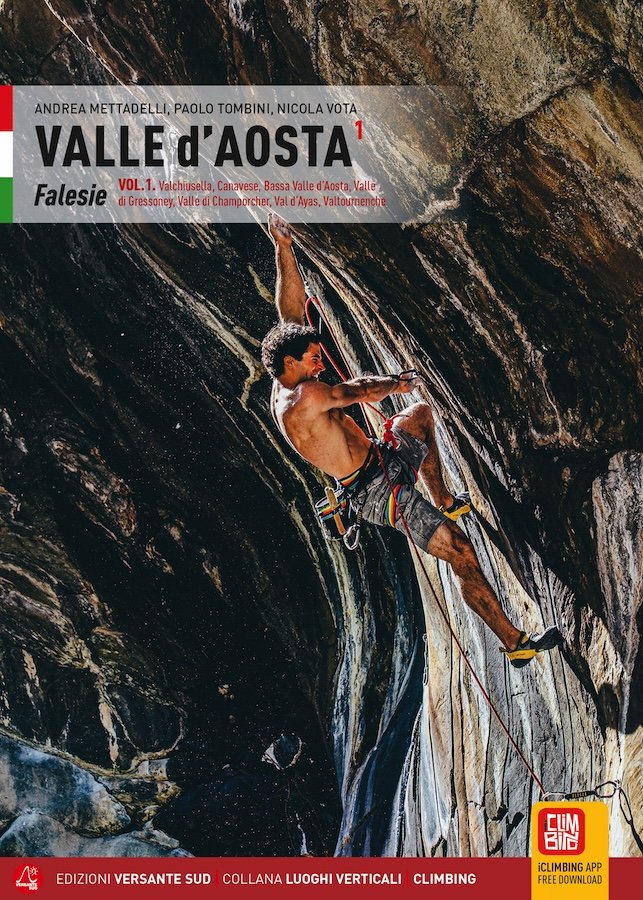
Vol.1 / Valchiusella, Canavese, Lower Aosta Valley, Lys Valley, Champorcher Valley, Ayas Valley, Valtournenche
Available variants

This guide is also available on the iCLIMBING app
-
Although the Aosta Valley is geographically quite small from a climbing perspective it is incredibly rich and varied. The landscape is distinctly alpine, shaped by a series of lateral valleys that all converge into the main valley carved out by the river Dora Baltea. Each one of these valleys has glacial origins and during the last ice age, the massive Balteo Glacier reached as far as today’s Canavese area.
The signs of its passage are still clearly visible and local climbers have made the most of the glacier’s ancient scratches carved into the sides of the main valley, equipping a remarkable number of crags that continue to grow year after year. While the first and most obvious sectors have helped establish the long history of sports climbing in the region, recent years have witnessed the development of new crags greatly expanding the local climbing opportunities and making the Aosta Valley one of Italy’s main hubs for outdoor climbing.
The lateral valleys which run from the main ridge of the Alps in a few dozen kilometers merge into the main valley and reach quite elevated altitudes and are densely packed with crags, mainly summer crags, making it possible to enjoy cool climbing days in the shade of the Alpine giants, with breathtaking views of the region’s 4000 meter peaks. During winter temperature inversion in the lower valley has the opposite effect, often allowing for sunny climbing even on the coldest days.
For this guidebook, the authors have chosen to focus on the eastern side of the Aosta valley and its side valleys, including the foothill areas of the Canavese area. Although this macro-area is administratively split between two different regions, for climbers it is a single, coherent territory: logistically straightforward, morphologically similar and offering, within a radius of about 50km centered around the Fort of Bard, an impressive number of crags suitable for all four seasons.
Andrea Mettadelli was born in Biella in 1971, he got into sports climbing during the 90s and his passion led him to explore countries near and far such as the United States and Africa, a bit for passion and a bit for work as a mountain guide. He enjoys ice climbing and all activities that alpinism has to offer, but during winter he is also a ski and snowboard instructor.
Paolo Tombini was born in Biella and has been a Mountain Guide since 2007, he mainly works in the Alps. His background ranges from climbing, where he has repeated routes up to 8a, to mountaineering in the Alps with classic and modern routes in Mont Blanc and the Dolomites. Overseas he has visited Yosemite Valley and climbed El Capitan as well as going on an expedition to Madagascar on the rock faces of Tsaranoro to open a new route. He has travelled extensively to Norway, Patagonia and the Himalayas. He has contributed as a writer to numerous articles and publications on mountaineering and climbing.
Nicola Vota, was born in Biella in 1970. He started climbing in 1988 thanks to a Biella CAI climbing course, he then became a climbing instructor in 1991. He loves climbing, and has explored all its forms which vary from sports climbing, bouldering, trad routes, mountaineering and ice climbing. He has four children whom he has taught to move on rock from a very young age, he works professionally in software development.
-
Year 2025ISBN 978 88 55471 893Pages 424Height (cm) 21.0Width (cm) 15.0Thickness (cm) 2.0Weight (kg) 0.63Series code LV 184/1Language Italian